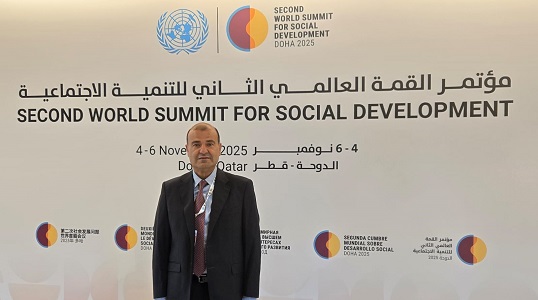
The Secretary-General of the Union of Arab Chambers, Dr. Khaled Hanafy, headed the delegation of the General Secretariat that participated in the Second World Summit for Social Development 2025, held from November 4 to 6 at the Qatar National Convention Centre, under the patronage and in the presence of His Highness Sheikh Tamim bin Hamad Al Thani, Emir of the State of Qatar, with the participation of heads of state, prime ministers, and prominent international figures.
In his speech during the opening session of the summit, Dr. Khaled Hanafy stressed that economic and social empowerment can only be achieved through genuine financial inclusion and effective digital transformation, ensuring the integration of all segments of society and creating equal opportunities for everyone. He added that the shift toward a more inclusive digital economy represents a long-term investment in human capital and contributes to narrowing development gaps while enhancing productivity and social justice.
Hanafy affirmed that integrating persons with disabilities into this system is not merely a humanitarian duty but also a promising developmental opportunity, by employing their capabilities within a supportive digital work environment that contributes to building more sustainable communities.
He pointed out that the Union of Arab Chambers, as a platform representing the Arab private sector, is working diligently to promote financial inclusion and digital transformation in the Arab world through regional initiatives, international partnerships, and empowering entrepreneurs and marginalized groups to enter the formal economy, in line with the requirements of sustainable development and the vision of the modern economy.
He considered the Qatari experience in this field to be a model to be emulated, as it combines social vision with technological modernization within a partnership between the public and private sectors, in harmony with the Sustainable Development Goals 2030, thereby enhancing the ability of Arab societies to confront current and future developmental challenges.
As part of the inauguration of the third session of the “Living Independently for Persons with Disabilities” initiative and its accompanying exhibition, Dr. Khaled Hanafy stated that “the opening of the third session of the initiative marks the continuation of a pioneering national and humanitarian path in empowering persons with disabilities and ensuring their active participation in sustainable development.” He explained that “this gathering is a clear message that building inclusive societies can only be achieved when everyone, without exception, is granted the right to a dignified life and independent living.” He emphasized that “the private sector can be a vital partner in this transformation by working to provide flexible and accommodating job opportunities that match the abilities of persons with disabilities and ensure them decent and sustainable work, while also expanding the production and adoption of assistive technologies and designing products and services in an ‘inclusive’ manner that leaves no one behind.”
During the high-level side event held as part of the summit, titled “Towards Inclusive Social Integration: Independent Living for Persons with Disabilities and Poverty Eradication,” the Secretary-General of the Union addressed “the role of the private sector in supporting economic development and independent living for persons with disabilities,” noting that “integrating persons with disabilities into the economic system is both a human and social right, as well as a smart investment in human capital, productivity enhancement, and reducing development disparities.”
The Secretary-General of the Union, Dr. Khaled Hanafy, called for “the adoption of comprehensive employment and diversity policies, the creation of inclusive work environments, partnerships with organizations of persons with disabilities and civil society, the innovation of inclusive products and services, the measurement of impact and transparency, the enhancement of institutional culture, and greater motivation through supportive policies and incentives.”
Dr. Hanafy also delivered a speech at the session titled “Resilient Economies, Inclusive Justice: Cooperative and Gender-Aligned Approaches in Artificial Intelligence,” organized by the Women and Youth Advancement Foundation (WOYA) during the Second World Summit for Social Development 2025. He pointed out that, in the era of digital trade, artificial intelligence, data analytics, smart logistics, and blockchain technology (a decentralized system for secure data recording and transactions), the goal must be to ensure that the digital trade infrastructure is gender-responsive and inclusive of youth, and that opportunities in digital knowledge and entrepreneurship reach young men and women across the region—not only in urban centers, but also in rural, underserved, and post-conflict areas.
He said: “At the Union of Arab Chambers, we promote a regional model of responsible business that integrates environmental, social, and governance (ESG) principles, AI ethics, and inclusivity metrics into the private sector’s agenda. We encourage chambers of commerce across the region to partner with governments, multilateral development agencies, and civil society organizations to enhance women’s access to trade finance, youth training programs in digital and green sectors, and regional value chain linkages that include small and medium enterprises, especially those led by women and young entrepreneurs.”
During his stay in Doha, Dr. Khaled Hanafy, Secretary-General of the Union of Arab Chambers, visited the headquarters of Qatar Chamber, where he met with the chamber’s Director General, Ali Saeed Bu Sherbak Al Mansouri, in the presence of the chamber’s advisor, Sayed Ragab. The meeting discussed the state of cooperation between the Union of Arab Chambers and Qatar Chamber, and the importance of the role played by the Arab private sector in development and in strengthening Arab economies. At the conclusion of the meeting, Al Mansouri presented a commemorative shield to the Secretary-General in appreciation of his efforts to elevate the status of the Union of Arab Chambers and the Arab private sector.
Source (Union of Arab Chambers)
