
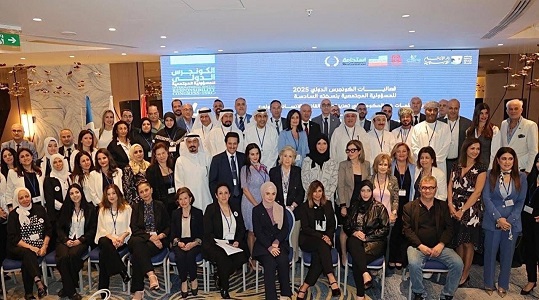
The Union of Arab Chambers participated in the activities of the Sixth International Congress on Social Responsibility, organized by the Social Welfare Institutions in Lebanon – Dar Al-Aytam Al-Islamiyah, under the patronage of the Prime Minister of Lebanon, Dr. Nawaf Salam, and in partnership with the Regional Network for Social Responsibility. The event saw wide Lebanese and Arab participation from official, parliamentary, diplomatic, economic, and media figures.
The Congress included scientific and discussion sessions. The first scientific session addressed the topic “The Role of Non-Governmental Organizations in Promoting Respect for International Humanitarian Law.” The second scientific session was titled “Global Professional Tools for Addressing Practical and Field Challenges Facing NGOs in Their Humanitarian Work.”
A side event was also held under the title “Corporate Social Responsibility and Social Welfare Conference – Effective Partnerships in Challenging Environments.” It included a first discussion session on “The Role of the Private Sector in Consolidating Social Responsibility and Supporting Vulnerable Groups.” The event concluded with the launch of the “Athar Charter for Social Responsibility” as a regulatory framework for partnership between the public and private sectors, aiming to consolidate the principles of governance, transparency, and the sustainability of social impact. The second discussion session was titled “The Legal and Financial Framework Governing Fragile Social Responsibility,” while the third scientific session discussed the topic “Strategies for Building Competence and Capacity in International Humanitarian Law.”
Recommendations
The proceedings of the Sixth International Congress on Social Responsibility concluded with a set of recommendations aimed at strengthening the humanitarian and social work system and consolidating the principles of social responsibility in the Arab world. The most prominent of these recommendations were as follows:
· Strengthening effective partnerships with international, regional, and global civil society organizations.
· Transforming the role of organizations from reaction to initiative, thereby enhancing the effectiveness and sustainability of humanitarian work.
· Establishing joint Arab digital platforms to exchange evidence and reference practices in humanitarian work.
· Issuing a unified Arab guide on the ethics of field humanitarian work to serve as an accredited reference in the region.
· Integrating humanitarian ethics training into qualification programs for workers in the humanitarian and social sectors.
· Activating ethical monitoring and evaluation mechanisms to ensure compliance with standards of integrity and transparency.
· Embedding humanitarian culture within education and media systems to promote values of solidarity and responsibility.
· Adopting the principles of good governance, transparency, and international accountability in managing community work.
· Developing advanced professional and ethical mechanisms to improve institutional performance in humanitarian organizations.
· Establishing practical visions and quality initiatives that promote respect for international humanitarian law in Arab contexts.
· Affirming the Lebanese government’s commitment to providing practical support for every initiative that contributes to sustainable development and enhances values of citizenship and trust between citizens and institutions.
· Calling on the private sector and civil society institutions to engage in a comprehensive national project that positions social responsibility as a driving force for building a new Lebanon.
· Emphasizing the interconnection between economic vision and moral duty to achieve human development and enhance sustainable financing for community projects.
· Identifying the professional competencies required in training fields and adopting clear systems and standards for programs and trainers.
· Encouraging the establishment of Arab alliances for training, capacity building, and experience exchange in humanitarian and community work.
· Calling for the adoption of the “Arab Social Responsibility Index” developed through the “Sociality” platform as a unified measurement tool for responsible practices in the Arab world.
Source (Union of Arab Chambers)
